‘Enlightenment…don’t know what it is…’
Thus runs the line from Van Morrison’s song, from the 1990 album, ‘Enlightenment’.
Certainly, if you take on board Mr Parson’s conclusions in ‘The Open Secret’ then not only is there nothing to be done to ‘become enlightened’ but also, according to Tony, there’s ‘no-one’ there anyway to be enlightened, but, in order to arrive at these conclusions, it seems that quite a bit has to be ‘done’ in terms of spiritual time and effort!
All very paradoxical and confusing.
Spiritual development is often seen as a ‘journey’, a metaphorical/ symbolic rather than a physical one, though described in physical terms, for example as in John Bunyan’s 1678 allegory, The Pilgrim’s Progress’, which chronicles the hero Christian’s dream journey from The City of Destruction (Sin) to The Celestial City (Heaven/Redemption), and there are countless other ‘journey stories’ in all literary genres.
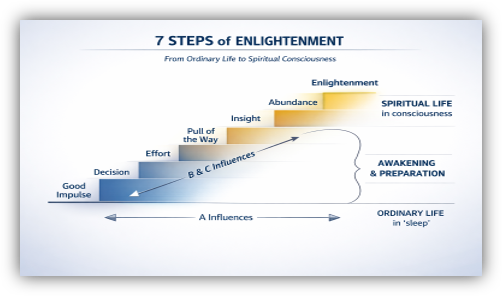
The representation of the journey to enlightenment in the above diagram probably has its origins in the teachings of the Armenian philosopher and teacher George Gurdjieff (1866-1949), who then passed these on to his student Pyotyr Ouspensky (1878-1947). Ouspensky settled in London and his teachings influenced the founding of The Study Society, which is still in existence to this day.
As can be seen, this this version of the ‘process’ of enlightenment contains three main elements – the 7 steps themselves, the 3 ‘levels’ of life, and 3 ‘influences’. Let’s take a closer look.
Influences
‘A’ influences are created in, or by, life itself.
They include influences of race, nation, climate, family, education, society, profession, manners and customs, wealth, poverty, current ideas and so on. They are mechanical in origin and effect, and not designed to raise our level of consciousness, nor wake us up to the greater potential we have within.
‘B’ influences are created outside this life.
They are esoteric influences created by Men of Understanding, belonging to what is sometimes called the ‘Inner Circle’ of mankind.
Unlike ‘A’ influences, these are conscious in their origin, created by conscious people for a definite purpose. Such influences are usually embodied in religious systems and teachings, philosophical doctrines, works of art and so on.
Let out into life for definite purposes, ‘B’ influences become mixed with ’A’ influences. They fall under the general law of mechanical influences, and by change and distortion, merge into, and become, ‘A’ influences. So though conscious in origin, they become mechanical in effect.
What is crucial for a person is separating these two kinds of influence. If the person begins to discriminate between them, and ‘put on one side’ the ‘B’ influences not created in life itself, their discrimination becomes sharper and in time the person no longer confuses them with ‘A’ influences.
These ‘B’ influences from outside life gradually collect together within him, so that he remembers them together, & feels them together. Eventually they form in him a kind of ‘magnetic centre’, which grows by attracting similar influences & the person begins to understand the idea of ‘a Path’ and search for it.
‘C’ Influences.
The searcher may then meet someone else who knows the Path and who is connected directly, or through others, with a centre existing outside the mechanical laws of life, from which the ideas that created the magnetic centre originally came. The searcher can now come under what may be called ‘C’ influences that are direct and conscious in both origin and effect.
Whereas B influences can spread through books, philosophical systems & rituals etc., ‘C’ influences can only pass from one person to another, directly by means of oral transmission. It is only through ‘C’ influences that an individual may escape the mechanical laws of life and find the way that leads to the freedom of clear consciousness.
The First Four Steps
- Good Impulse. (Shubhecchaa)
‘There are many ways to come to a good impulse. It could be a good book, a school, a holy man, or a teacher, or even an incident in one’s life. All these, or any one of them, could remind individuals of something latent in them, and they could make a move to materialise it’. [HH conversation 74.2.2.]*
‘Impulse comes from within. It often manifests as a memory that there is more to life than meets the eye. The writer Anne Gage described how, at the age of twelve, she heard a voice say ‘I AM’.
She later wrote; “The experience never came again. But it is enough to stir me to action. I have discovered something I did not know existed. What is within? What am I? I will not rest until I know.’ {The One Work – 1961}
- Decision. (Suvichaaranaa)
‘….The good impulse …..is a pure desire of the Absolute, manifesting in stages with various individuals to perform their functions to please Him. In following this pure desire, a person will soon find himself divided in opposing loyalties. This unrest of mind will call for knowledge and guidance. With such help, even though negative forces seem to press very hard, a decision is reached and this establishes his way.’ [HH conversation 74.2.2.]
‘Once good Impulse arises, the individual must take a firm decision to act upon it, whether they can justify it logically or not. This decision can be helped by the company of others who have already decided, or it may be hindered by the fear of something unknown, or again distractions arising from more superficial levels of mind.’ Being Oneself: The Way of Meditation’**
3. Effort. (Tanumaanasaa)
‘The person settles down for Truth and discipline. They would work hard and move in steadiness and fairness. This naturally keeps them away from evil, wrongs and a number of vices. Their inner being starts being cleansed and purified. Their collections of the past, which hitherto clouded mind & emotions, would lose their hold over them, leaving them lighter, more efficient, untiring, and more capable within and without. Loss or misuse of energy having been stopped more energy is available for useful work.’ [ HH conversation 74.2.2.]
‘Having found a source of knowledge and guidance, one comes to the effort of putting the guidance into regular and effective practice. This means following instructions simply and leaving behind imaginings. Developing inner stillness, one comes to know ‘right effort’ & abandon ‘wrong effort’ – the temptation to make things more difficult for oneself by claiming to be the doer.”’ [‘Being Oneself’, SoM.1985]
‘At this stage reason or truth has an appeal for the individual; he shows readiness to notice and accept it. But this does not mean that he will always stand by truth and reason. He may still be waylaid, attracted to something, perhaps not even to his liking, yet would go with it for no reason. In this stage love of truth, and its complimentary aspect, discipline, keep the person on the way of development of being. But samskaras may disrupt them. Certainly, the individual is gaining more strength and cutting out many shortcomings but is not out of danger.’ (HH conversation 74.3.3)
- Pull of the Way. (Sattvaapatti).
‘As rajas and tamas are reduced sattva increases and every aspect of the aspirant’s being becomes bright. He not only lives in the light, but he himself sheds light, so that things and situations begin to transform. As the person moves into the region of light, discriminating between good & bad, right & wrong etc is no longer a matter of convention or association. Seeing the situation under the light of sattva, they observe the facts as they are and, without falling prey to the delusion of sentimentality, they go for the good and the right. Living in the region of light, he has no fear because it only originates from darkness and ignorance. He is now steady, upright, unhesitant, clear, and prepared for the next steps.” [HH conversation 74.2.2.]
Maintaining Progress
Are these states stable and permanent, or are there fluctuations from time to time?
‘The disciple’s development is hindered or helped by the inner element of their samskaras and the outer element of the company they keep. The first three stages are all tender stages, and unless cared for by good company and supported by good samskara, one would find fluctuations or fall. Bad samskara or bad company could easily distract a disciple from the way for a shorter or longer time depending on their strength. They may re-awaken and try to pick up the threads again and this may happen many times.
However once the state of the individual at the fourth stage has matured, they become steady in their approach to right & wrong. So the fourth and higher states are very steady and safe, while the lower stages need much care, love, attention, knowledge reminders to save them from distractions and fluctuations.
The early stages need care. After the fourth stage, the stages not only take care of themselves, but also provide care, protection and love for the development of others.’ [HH conversation 74.3.4.]
The Three Later Stages
- Insight. (Asangsakti = power of detachment).
‘At this level the vision of the person undergoes a great change, for, freed of attachment, they now see beyond the apparent and become far freer. They enjoy the brilliant and attractive appearance of all things yet never hanker for nor chase after them. They see everything new and respond naturally to it, not from past or future, but from the present which flashes the will of the Absolute.
They still know their own being as separate from things and the Absolute. The drama around them and the enjoyment it gives is all known as having a special significance, and yet nothing seems to bind them. They are only bound by love and in this detached state respond to the will of the Absolute. They see the world as it is without any personal reference to themselves.’ [HH conversation 74.2.2.]
‘ Asangsakti literally means ‘power of detachment’. Because he understands them thoroughly well, he has enough will to select the right and reject the wrong. The person can now be fully detached only because he has come to understand the potentially of all things and situations. He can see right and wrong, or good and bad, so is not pulled by them.
Since he has the power to discriminate between the qualities of all things, and not being in a hurry, he has all the time to consider usefulness, and he also knows the direction of his way. He just chooses what is good, so the attraction of things does not move him. This detachment allows the play of the Absolute to keep moving in its natural rhythm without any hindrance or pollution by the individual.
In the Bhagavad Gita (Ch.5) Krishna says that ‘such a man looks, touches, walks, eats, gives, takes and does everything which comes his way, and yet it seems as if he had done nothing at all, because of detachment.’ This is the quality one finds at this level.’ [HH conversation 74.3.2.]
- Abundance. (Padaarthaa-bhaavinii)
‘At this level apparent and manifest forms are seen, but it is also seen that the apparent forms are held by the unmanifest, the cause, the substance that is about to create new forms or bring changes to existing forms. Outer and inner being are seen together. One experiences the will of the Absolute unmanifest, holding all space, all time and all gunas. Earth and pot are seen simultaneously. Likewise, table and wood, ornament and gold, thread and cloth. Everything seems like nothing but the body & being of the Absolute. Things become transparent. They do not disappear, are not negated, yet they are transcended and both the laws and the maker of the laws are seen. The person is like a lover, who cannot see anything but his beloved in everything and all times. There is nothing more than he and she, or the individual and the Absolute.’ [HH conversation 74.2.2.]
- Full realisation. (Turiiyaa).
‘The next dive is into the union. The diver, the depth and the diving are known and experienced as one. The drama goes on, the person stops nowhere; he stops nothing, but allows all things to happen. In union he only knows himself to be Absolute and he does act as an Absolute.
He has creative power and he uses it without any claims whatsoever. This state is called Turiiyaa. This is hardly a state, for all states are within it. It is the fulness, the oneness, the reality, something unqualified and indescribable. There is the Absolute without a second. This is where vyashti becomes Samashti.’ [HH 74.2.2.]
NB; # vyashti = singleness, individuality. Where a person sees themselves outwardly as being part of a whole (e.g. human race), and inwardly as being composed of different parts (body, breath, mind etc).
# samashti = attainment, conclusion, collective existence, totality.
Turiiyaa is experienced internally and externally. When the individual dives deep within, then their associations, confrontations, engagements and relations come to a stop and they, being one within, enjoy this bliss and consciousness.
When they rise from this deep state into the awakened state of the world, they come out of the ocean of bliss and consciousness and there is abundance of freshness, pious thoughts, deep and kind look in the eyes. They are never in a hurry; there is no excitement or agitation in their movements and they always remain placid and pleased. All they do goes with a natural rhythm and according to time.
They love everyone and in return, get love and devotion from anyone who works for them. Even the so-called enemy becomes friendly. Many miraculous things happen to them, such as direct communion with angels, seers or lawgivers etc. Always with bliss and compassion for everyone, they have great powers to face up to or correct any situation. The wave of love keeps flowing through them.’ [HH conversation 74.3.1.]
* The Record of (H.H.) Shantanand Saraswati is a comprehensive written archive of the audiences, interviews and correspondence. It took place over an 32 year period between Dr. Francis Roles, members of The Study Society and His Holiness (H.H.) Shantanand Saraswati, Shankaracharya of Northern India.
** Being Oneself: The Way of Meditation is an 87-page instructional and philosophical book written by F.W. (Bill) Whiting and published by the London-based School of Meditation in December 1985.